Civic Assembly Ratifies Water Policy Recommendations for the Nevada Legislature
From August 28-30, 2026, 49 Nevadans from across the state participated in a historic Civic Assembly hosted by The Nevada Forum. Over three days, these delegates drafted, deliberated, and voted on policy directives, with six receiving supermajority support.
Representing the geographic, political, and demographic diversity of Northern, Southern, and rural Nevada, the delegates gathered to tackle critical issues surrounding water sustainability, allocation, and long-term resource management. Working alongside nonpartisan facilitators from The Nevada Forum, as well as independent subject matter experts, the delegates transformed months of statewide public input into actionable legislative recommendations ahead of the 2027 Nevada Legislative Session.
49
Assembly Delegates
3
Days, Four Working Sessions
6
Directives Passed
>70%
Supermajority Achieved
02
Who Participated
The Nevada Forum Civic Assembly's delegates were randomly selected and demographically matched to represent the state's adult population. Across their differences, they deliberated and collaborated to understand Nevada's water issues and develop policy directives.
Region
South
68%
North
18%
Rural
14%
Political Lean
Very conservative
8%
Conservative
26%
Moderate
34%
Liberal
22%
Very Liberal
10%
Race / Ethnicity
White
54%
Hispanic or Latino
26%
African-American
8%
Asian
6%
Other / Multiracial
4%
Native American
2%
Age
18-29
8%
30-39
22%
40-49
26%
50-59
28%
60-69
8%
70+
8%
03
What Was the Process
The Civic Assembly featured four in-depth working sessions over three days. Seven independent experts on water policy briefed the delegates and answered questions to inform their discussions.
Session One
Define the problem and criteria
Session Two
Build and evaluate policy actions
Session Three
Draft policy directives
Session Four
Revise, present, and vote
Delegates talked about these three water-related themes
Shared facts, planning, and accountable water decisions
Water-intensive growth and major projects
Long-term water reliability
04
What Was the Outcome
Delegates passed six comprehensive water policy directives, with a supermajority (>70%) of the delegates voting for each of the following recommendations to address the water issues facing our state.
The policy recomendations below contain the exact text approved by the Civic Assembly, including any notes or clarification the delegates made. They have not been altered or summarized in any way.
Share of delegates voting yes70% threshold
Top Proposal
90%
Directive Two
49
44 of 49 delegates voted yes
"Establish a Water Advisory Board to centralize current state-wide data into an easy-to-read, accessible public report and forecast to present to legislators before the start of each legislative session."
+−Read the full policyHide policy actions
Policy actions
Immediately within first year
Membership includes regional water authorities (county, state, north/south), independent experts, and stakeholders including: elected officials, tribal leaders, environmental groups, businesses, residents
Month 3-6
Publish currently collected data from Northern and Southern Nevada, released with a data dictionary and index, using volunteers if necessary
Month 6
Send newsletter that highlights heavy water users in each inventory
Month 12
GET THE WATER ADVISORY BOARD PASSED in 2027
Month 24
Prepare the report and forecast for the 2029 Legislative Session and post to the website of the Nevada Water Advisory Board
Other Proposals
84%
Directive One
49
41 of 49 delegates voted yes
"Improve accountability, transparency, and information in order to create a revised local and statewide water conservation policy."
+−Read the full policyHide policy actions
Policy actions
Action 1
Require the state to publish a public platform online showing current water status trends, water rights records and forecasts in plain language to raise awareness and create policy to improve and enforce water conservation.
Action 2
Require the state to compile, complete, and publish statewide inventory and audit of Nevada’s water supply and use, and to update them annually.
Action 3
Require water authorities across Nevada and large users as defined by the state to report water use into one public statewide record, including but not limited to new housing developments, golf courses, and data centers.
Final clarification
This action plan will lead to more accurate data, data reliability and making efficient policy decisions on verified data compiled from across the entire state of Nevada.
84%
Directive Five
49
41 of 49 delegates voted yes
"Implement creative options to ensure Nevada’s growing needs for water are met now and into the future."
+−Read the full policyHide policy actions
Policy actions
Action 1
Host a multi-state/federal convention in Nevada to revise the agreement governing Colorado River allocations (The Compact), ensure Nevada participates with knowledgeable negotiators, and re-negotiate Colorado River allocations based on up-to-date, accurate information.
Clarification: The Compact is based on misleading data that is over a century old. It was taken during the wettest decade in a thousand years and has not been updated to account for climate change and growth.
Action 2
Pursue desalination partnerships or exchanges of water credits with other states or Mexico that could free up Colorado River water for Nevada.
Clarification on the water credit idea:
Water is used at the source
About 70% of Nevada’s water comes from the Colorado River
Other states have claims to that water
Those states have other sources (e.g. desalination)
In exchange for Nevada investing in those other sources, we will receive additional allocations from the Colorado River
Action 3
Explore the potential development of an interstate water pipeline as a federal or multistate project.
Action 4
Strengthen state management of stressed groundwater basins, and support research/development of water-saving/supply technologies.
78%
Directive Three
49
38 of 49 delegates voted yes
"Establish a system around water-intensive projects that ensures transparency, community input, public benefit, and accountability to Nevada residents and taxpayers."
+−Read the full policyHide policy actions
Policy actions
Action 1
Require enforceable community-benefit commitments (such as local infrastructure investments) from developers in order for them to earn building incentives from the state.
Action 2
Mandate water-intensive projects to publicly disclose forecasted water use.
Action 3
Require the government to conduct a formal community input process (such as community conversations) before project approval.
Action 4
Require water-intensive projects to publicly report their actual water use on a quarterly basis.
Action 5
Assign a state agency to apply escalating penalties when commitments are broken.
73%
Directive Six
49
36 of 49 delegates voted yes
"Create statewide immediate short and long term action report to improve water sustainability for Nevada."
+−Read the full policyHide policy actions
Policy actions
Action 1
Institute a semi-annual and weather event specific report to inform demand side water rules and update conservation requirements for metering by the August prior to a legislative session.
Action 2
Semi-annual report will provide assessment necessary to fund expanding water reclamation and preserving wetlands in Southern Nevada and establish snowmelt / surface water recharge programs to buffer against drought in Northern Nevada.
Action 3
Semi-annual report will assess the need for expansion of the Department of Conservation and Natural Resource buyback program for voluntary water rights retirement and grandfathering water rights for wells.
Action 4
Construction of Desalination plant in Mexico to paper trade water with Nevada.
71%
Directive Four
49
35 of 49 delegates voted yes
"Require the establishment of a secondary review process, tailored to each county and initiated based on specified project types, to evaluate the cumulative economic environmental, infrastructure, and community impacts of large-scale development on the state’s long-term growth. The process shall ensure accountability through transparent decision-making, meaningful public participation, and proactive community involvement prior to project approval."
+−Read the full policyHide policy actions
Policy actions
Action 1
The legislature shall establish a multidisciplinary public body composed of subject matter experts, engineers, and technical representatives from relevant Nevada agencies.
Action 2
The public body shall establish the thresholds of criteria that determines which qualifying projects are subject to secondary review and conduct the evaluations of the projects that meet the established thresholds.
Action 3
The public body shall review and update the framework biannually using current data, emerging technologies, and the latest environmental, infrastructure, and community impact information to ensure the review process remains effective, relevant, and responsive to changing conditions. This framework will be adopted and approved by the Legislature.
Action 4
Require qualifying projects subject to secondary review, to publicly report their actual water and energy use on a quarterly basis after operations begin.
Action 5
Establish an enforcement mechanism in coordination with the office of the NV Attorney General, including penalties, repayment, or the recapture of public incentives when project commitments are not fulfilled. Any monetary penalties shall be directed to the county in which the violation or resulted impact occurred and used to address or mitigate local environmental, infrastructure, or community impacts.
Action 6
Upon completion of each secondary review the public body shall publish the review findings, determinations and supporting rationale to ensure transparency and public accountability.
05
In The Room
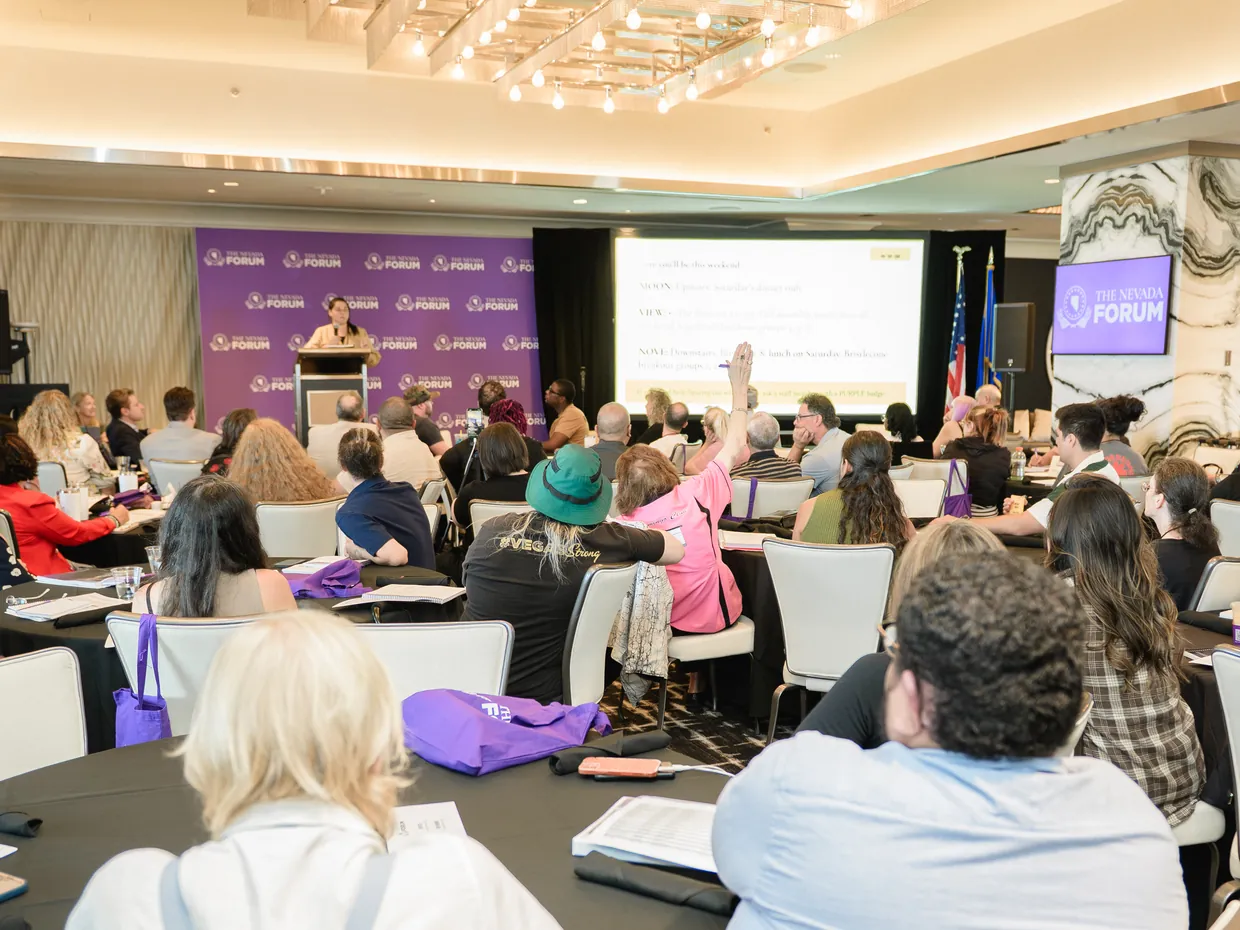
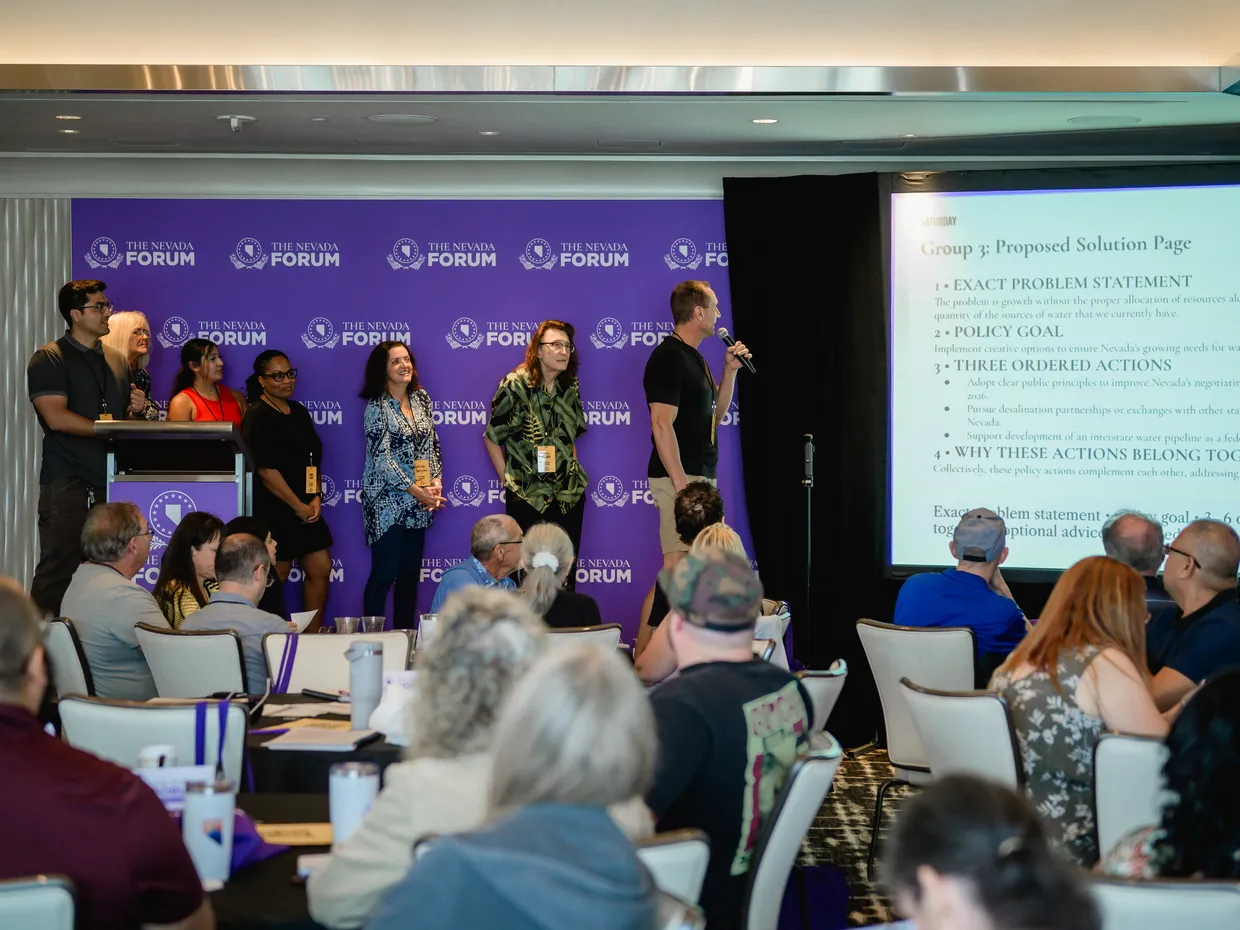
Three days at the Palms Casino Resort in Las Vegas. Six working groups, four deep-dive working sessions, three rounds of voting, one final set of ratified directives.
The Delegates
The Assembly Floor
Expert Advice
Working Group Readout
06
What Delegates Thought
In the voices of Nevadans, what they thought about the experience.
"I feel my participation in The Nevada Forum was productive because I had the opportunity to assemble with other Nevadans across the political spectrum…"
"It really helped me learn that you can come together to solve problems."
"I was overwhelmed with heartfelt gratitude that I was able to participate…"
"That the forum included all political parties and beliefs… Miraculous!"
Feedback on the process and future participation
9.81/10
9.81/10 - The average score delegates gave when asked whether they believe The Nevada Forum will positively impact Nevada.
98%
of post-event survey respondents rated their likelihood of recommending The Nevada Forum to a friend as 9 or 10 out of 10.
85%
of respondents (41 of 48) volunteered to particpate in The Nevada Forum's ongoing efforts.
07
How We Got Here
Phase One
Identify Top Concerns for Nevadans
Online Engagement
From March to May, we asked people across the state, "What do you want to see fixed in Nevada?" More than 30,000 Nevadans contributed issues, reactions, and votes, surfacing four top issue areas for the state to address.
In June and July, over 600 Nevadans signed up for online and in-person conversations around the 4 issue areas identified in Phase 1. Following these conversations, we convened a working group to help select the topic for our inaugural statewide civic assembly.
The Nevada Forum Civic Assembly isn't the end of our process. In fact, our work to translate citizen-led recommendations into state legislation is just getting started. Here's a snapshot of the road ahead:
1
September–October 2026
Engage Legislators
Goal: Partner with bipartisan legislators to submit a bipartisan Bill Draft Request (BDR).
Action: Build initial support and bring constituent priorities into the legislative agenda.
2
November–December 2026
Submit Policy for Legal Drafting
Goal: Engage the nonpartisan Legislative Council Bureau (LCB).
Action: Submit proposed policy to LCB counsel to draft formal statutory language.
3
Early 2027
Introduce and Advance the Bill
Goal: Formally introduce the BDR as an official bill in the Nevada Legislature.
Action: Present testimony, distribute policy briefs, and mobilize constituent support during committee hearings to earn endorsements.
4
Ongoing Strategy (2026–2027)
Mobilize Grassroots Advocacy
Goal: Drive public support throughout the entire legislative process.
Action: Empower Nevadans statewide to contact elected officials and advocate for the bill's passage.
Sign Up to Be a NV Forum Champion
Citizen-led recommendations only become law when Nevadans push for them. Sign up to help advance our water policy recommendations through the upcoming session of the Nevada State Legislature.